Welcome to Langfuse Academy
This is the place to build a mental model for AI engineering. We'll introduce the core disciplines teams rely on as LLM applications move from prototype to production.
Rather than focusing on individual product features, Academy is meant to help you understand the bigger picture, and how teams can work with that change in a systematic way.
Why LLM observability is different
Traditional observability remains essential. Teams still need to know whether their systems are up, whether requests are slow, whether dependencies are failing, and whether costs are under control. Those questions do not disappear when an application starts using LLMs.
But LLM applications introduce a different kind of challenge. Their behavior is probabilistic: the same input can produce different outputs, and a response can look plausible even when it is wrong, incomplete, off-brand, unsafe, or simply unhelpful. In other words, a request can succeed technically and still fail for the user.
TODO: insert a visual or an example here to break up the text
AI engineering is not only about reliability. It is also about quality. Teams need to understand whether the output was useful, grounded, safe, and worth the cost. Observability for LLM applications therefore sits closer to product quality and iteration than traditional application monitoring usually does.
Modern observability platforms for LLM systems increasingly treat prompts, responses, token usage, quality signals, and model-specific behavior as first-class telemetry.
The AI engineering loop
Because of this, AI engineering is iterative. Teams do not build once, ship once, and assume the work is done. They observe behavior, learn from it, improve the system, and evaluate the result over time.
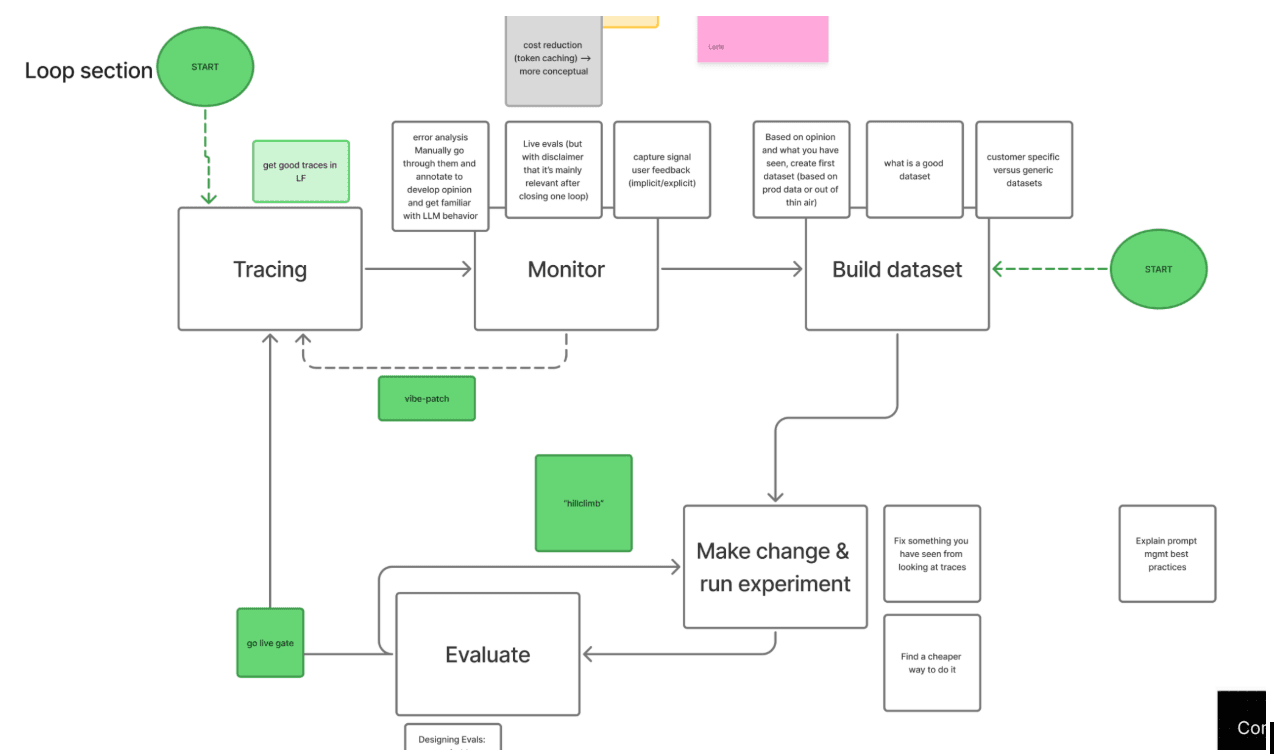
TODO: replace with final loop visual; should we explain each step in 1-2 sentences? Keep it concise
What comes next
The rest of Langfuse Academy goes deeper into each step of the loop.
Each section is designed to work on its own: it gives you an overview first, and then lets you go deeper if and when that makes sense for your use case. You can follow the full loop, or focus only on the parts that are most relevant for your team right now.
You also do not need to adopt everything at once. Most teams improve their setup iteratively over time, adding new practices as they become useful. Doing part of this loop is already better than having no LLM engineering practices at all.
Let's dive in!